Have you ever dismissed meditation because you thought it wouldn't help? Perhaps you've rolled your eyes at breathing exercises, thinking there's no way something as simple as breathing differently could ease your anxiety. Or maybe you've wondered how changing the way you speak to yourself could possibly make a difference.


You're certainly not alone.

Many of us are quick to dismiss these techniques. We might think they are too simple, too time-consuming or unlikely to make any real difference to how we feel.

But consider something interesting: professional athletes, performers and people working in high-pressure environments understand the importance of training their minds just as much as their bodies.

They don't leave their mental preparation to chance. They practise it.

So perhaps it's worth asking ourselves: if these techniques are considered valuable when preparing for a sporting performance, why do we sometimes dismiss them when it comes to managing our everyday lives?

1. Meditation: It's not about switching your mind off

One of the biggest misconceptions about meditation is that you have to sit quietly, clear your mind and stop thinking altogether.

If you've ever tried meditation and found yourself thinking about your shopping list, tomorrow's appointments or something that happened three years ago, you might have decided it simply wasn't for you!

But meditation isn't about having an empty mind.

It's about learning to notice where your attention goes and gently bringing it back.

Athletes use mindfulness and meditation as part of their psychological preparation. Before a competition, they may practise focusing their attention, noticing distractions and staying present rather than becoming consumed by worries about the outcome.

Think about how this might apply to everyday life.

You might be:

  • Replaying a conversation over and over.
  • Worrying about something that hasn't happened yet.
  • Thinking about everything that could go wrong.
  • Struggling to switch off after a busy day.
  • Finding it difficult to concentrate because your mind is constantly jumping between worries.

Mindfulness can help us become more aware of these patterns rather than automatically getting caught up in every thought.

The aim isn't to stop thoughts from happening. It's to change how we respond to them.

2. Self-talk: The conversations we have with ourselves matter

Imagine an athlete preparing for an important race.

They could be thinking:

"I'm going to fail."

"I'm not good enough."

"Everyone else is better than me."

"I'll never manage this."

Now imagine how that internal conversation might affect their confidence, concentration and approach to the competition.

Athletes often work on developing more helpful self-talk because they recognise that the way they speak to themselves can influence how they approach challenging situations.

Yet many of us don't give our own internal dialogue a second thought.

We might regularly tell ourselves:

"I'm useless."

"I can't cope."

"I always get things wrong."

"Something bad is going to happen."

"Why am I like this?"

We can become so accustomed to this way of thinking that we barely notice it.

But imagine hearing someone else speak to you in the same way you sometimes speak to yourself. Would you consider it supportive?

This is where CBT (Cognitive Behavioural Therapy) can be particularly helpful.

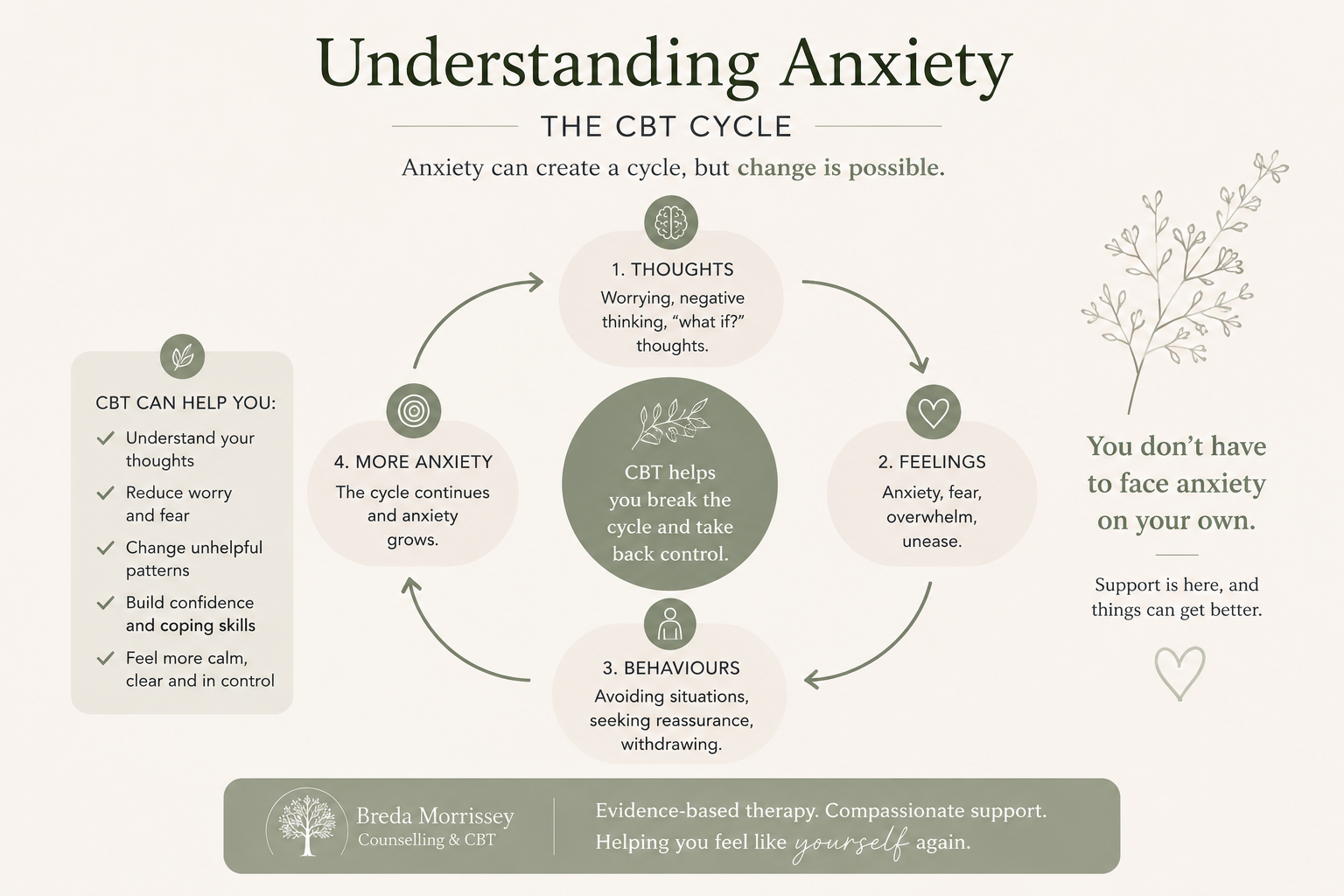
CBT explores the connection between our thoughts, feelings, physical sensations and behaviours.

Our thoughts aren't necessarily facts. However, the way we interpret a situation can influence how we feel and what we do next.

For example:

Situation: You make a mistake at work.

Automatic thought: "I'm useless at my job. Everyone will think I'm incompetent."

Feeling: Anxiety, embarrassment and self-doubt.

Behaviour: You withdraw, avoid asking questions or spend hours worrying about the mistake.

Now consider a more balanced response:

"Everyone makes mistakes. I can learn from this and put it right."

The situation hasn't changed, but your interpretation of it has.

This doesn't mean pretending everything is wonderful or forcing ourselves to think positively. It means learning to recognise unhelpful thinking patterns and developing a more realistic, compassionate and balanced inner voice.

3. Breathing: Why something so simple can make a difference

When anxiety takes hold, our breathing can change.

We might notice ourselves breathing more quickly, taking shallow breaths or feeling unable to get a satisfying breath.

Our bodies are responding to what they perceive as a threat.

Athletes understand the importance of breathing as part of managing their physical and mental preparation. Before and during demanding performances, controlled breathing can help them manage arousal, regain focus and settle themselves.

So why do we sometimes think breathing exercises won't help when we're anxious?

Perhaps it's because breathing seems too simple to make a difference.

But our breathing is one of the few bodily processes we can consciously influence.

Slowing down our breathing, particularly by allowing a gentle, longer exhale, can help support the body's calming response.

You don't need complicated equipment or a special environment.

Try this:

A simple breathing exercise

  1. Find a comfortable position and allow your shoulders to relax.
  2. Breathe gently in through your nose for a count of four, if comfortable.
  3. Slowly breathe out for a count of six.
  4. Avoid forcing or taking unusually deep breaths.
  5. Repeat for one or two minutes, allowing your breathing to settle naturally.

If counting feels uncomfortable, simply focus on making your exhale a little slower and more comfortable.

Remember, the purpose isn't to force anxiety away. It's to give your body an opportunity to settle.

4. The difference between knowing a technique and practising it

Here's something important.

An athlete doesn't expect to run a marathon without training. They don't expect to improve their performance by reading about running or trying something once.

They practise repeatedly.

The same principle applies to our mental wellbeing.

We might try meditation once, find our minds wandering and decide it doesn't work.

We might practise breathing for 30 seconds when we're already overwhelmed and feel disappointed that our anxiety hasn't disappeared.

We might tell ourselves something positive once and wonder why our thinking hasn't changed.

But these are skills that develop through practice.

The more regularly we practise noticing our thoughts, responding differently to difficult situations and becoming aware of our breathing, the more familiar these skills can become.

It isn't about getting everything right. It's about building small habits that we can draw on when life becomes challenging.

5. You don't have to be an athlete to benefit from mental training

You might never compete in a race, play in a final or perform in front of an audience.

But everyday life brings its own pressures.

An important meeting, a difficult conversation, financial worries, relationship challenges, caring responsibilities, work stress or simply trying to manage a busy household can all place demands on us.

We often spend considerable time looking after our physical health, but how much time do we spend looking after the way we think, respond and manage our emotions?

Perhaps we could learn something from athletes.

They recognise that physical preparation and mental preparation go hand in hand.

We don't have to wait until we're overwhelmed, anxious or struggling before we begin developing these skills.

And we don't need to be perfect at them.

We just need to be willing to practise.

A final thought

The next time you find yourself thinking, "Meditation won't work for me", "Breathing exercises won't help my anxiety" or "What's the point in changing how I talk to myself?", consider this:

If we recognise the importance of training our minds to help us perform under pressure, why wouldn't we give those same mental skills a place in our everyday lives?

Our minds deserve attention and care just as much as our bodies do.

Sometimes, the smallest changes in how we breathe, think and respond can be a worthwhile place to start.


Need a little support?

At Breda Morrissey CBT & Counselling, I offer online CBT and counselling sessions for adults across Ireland.

You don't have to wait until things become overwhelming to seek support. Sometimes having a space to understand your thoughts, explore your feelings and develop practical coping strategies can make a real difference.

Breda Morrissey | CBT & Counselling

🌐 www.bredamorrissey.com

📧 bredamorrisseycounsellor@gmail.com

📍 Online sessions available across Ireland.
by Breda Morrissey • 14 October 2026
Online CBT Therapy for Anxiety: How It Can Help You Feel More in Control By Breda Morrissey | CBT & Counselling Do you ever find yourself overthinking conversations, worrying about things that might happen, or feeling as though your mind simply won’t switch off? Perhaps you notice your heart racing, feel tense, struggle to sleep, or find yourself avoiding situations that make you anxious. Anxiety can affect many areas of our lives, from relationships and work to sleep, confidence and everyday activities. Sometimes, even when we know our worries may be out of proportion, it can be difficult to break the cycle. The good news is that you can learn new ways of understanding and managing anxiety . Cognitive Behavioural Therapy (CBT) is one approach that can help, and online CBT therapy makes accessing support more convenient. What is CBT and how does it help with anxiety? CBT is a talking therapy that explores the relationship between our thoughts, feelings, physical sensations and behaviours. When we feel anxious, we may automatically imagine the worst-case scenario, interpret uncertainty as danger or underestimate our ability to cope. These thoughts can increase physical symptoms of anxiety and lead us to avoid situations that feel uncomfortable. Although avoidance can bring temporary relief, it can sometimes reinforce our fears over time. For example, imagine you are invited to a social event. You might think, “I’ll feel awkward, nobody will talk to me, and I won’t know what to say.” This could leave you feeling anxious, with a racing heart and a strong urge to cancel. If you stay at home, your anxiety may ease temporarily. However, you miss the opportunity to discover that you might have managed better than expected. CBT helps you recognise these patterns, question unhelpful assumptions and gradually develop more helpful ways of responding. Research and clinical guidelines support CBT as an effective treatment option for anxiety disorders (NICE, 2020). What happens during online CBT therapy? Online therapy allows you to work with a therapist through video sessions from a space where you feel comfortable and private. During sessions, we can explore what triggers your anxiety, identify recurring thought patterns and understand the behaviours that may be keeping you stuck. Depending on your needs and goals, CBT techniques may include: Understanding anxious thoughts: Learning to recognise unhelpful thinking patterns and consider alternative perspectives. Managing overthinking and worry: Developing practical strategies to step back from repetitive worries rather than getting caught up in them. Gradually facing fears: Building confidence through manageable steps instead of continually avoiding situations that cause anxiety. Understanding physical symptoms: Exploring how anxiety affects your body and practising techniques to respond more effectively. Building confidence and self-belief: Identifying underlying beliefs and developing a more balanced view of yourself and your abilities. CBT is collaborative. You and your therapist work together to identify what is important to you, agree on realistic goals and practise skills that you can use in everyday life. The aim is not to eliminate every anxious thought or feeling. It is to help you respond differently to anxiety so that it has less control over your decisions and your life. Is online CBT as useful as attending therapy in person? Online therapy offers a flexible way to access professional support without travelling to appointments. You can attend from home, fit sessions around work or family commitments, and access support even if you live outside a major town or city. For many people, being in a familiar environment can also make it easier to talk openly. CBT can be delivered online, in person or by telephone, although the most appropriate approach depends on your circumstances, needs and preferences. Evidence-based online interventions are also recognised in clinical guidance for anxiety (NHS; NICE, 2023). You will need a private space, a reliable internet connection and a device suitable for video calls. A small step you can try today The next time you notice anxiety building, pause and ask yourself: What am I telling myself about this situation? What evidence supports my worry, and is there another way of looking at it? What small, helpful action could I take, even if I still feel anxious? You do not need to feel completely confident before taking a step forward. Sometimes, confidence develops through discovering that you can manage situations you once found difficult. If anxiety is persistent or interfering with your daily life, professional support can help you explore these patterns in greater depth. Taking the first step towards managing anxiety You do not have to navigate anxiety alone, and seeking support does not mean that you have failed to cope. It is an opportunity to understand yourself better, develop practical skills and begin making changes at a pace that feels manageable. I’m Breda Morrissey, an accredited therapist specialising in CBT, counselling and psychotherapy . I offer online therapy sessions for adults across Ireland, providing a supportive, collaborative and non-judgemental space to explore difficulties and work towards meaningful change. If anxiety, overthinking or worry is affecting your everyday life, you can learn more about my services at www.bredamorrissey.com . You deserve support, understanding and the opportunity to feel more confident in your everyday life. References and further reading National Institute for Health and Care Excellence (NICE). (2020). Generalised anxiety disorder and panic disorder in adults: management . Clinical guideline CG113. National Institute for Health and Care Excellence (NICE). (2023). Digitally enabled therapies for adults with anxiety disorders . Health technology guidance HTG676. NHS. Cognitive behavioural therapy (CBT) . An overview of CBT, how it works and the conditions it can help with.
by Breda Morrissey • 17 September 2026
Caring for a loved one with dementia is one of the most profound acts of love and dedication a person can undertake. Yet, it is also a journey that demands an immense physical, emotional, and psychological toll. When you are entirely focused on managing someone else’s changing reality, memory loss, and daily safety, it is incredibly easy for your own well-being to slip into the background. At Breda Morrissey CBT and Counselling, I frequently meet caregivers who are operating on absolute empty. If you are caring for a partner, parent, or relative with dementia, please know this: feeling overwhelmed, exhausted, or even guilty does not mean you are failing. It means you are human, and you deserve support too.  The Invisible Weight of Caregiving Dementia doesn't just impact the person diagnosed; it fundamentally changes the lives of their family members. Caregivers often experience what is known as "anticipatory grief"—grieving the loss of the person as they once were, even while they are still here. Over time, the chronic stress of caregiving can manifest as: Persistent Anxiety and Overthinking: Constantly worrying about what might happen next or whether you are doing enough. The "Guilt Trap": Feeling guilty for wanting a break, losing your patience, or feeling resentful about the situation. Physical Exhaustion and Isolation: Withdrawing from friends, hobbies, and social networks due to a lack of time or emotional energy. If left unaddressed, this level of sustained stress can lead to burnout. Fortunately, evidence-based psychological therapies like Cognitive Behavioural Therapy (CBT) and Acceptance and Commitment Therapy (ACT) offer powerful tools to help you navigate these complex emotions. How Cognitive Behavioural Therapy (CBT) Can Help CBT is a practical, goal-oriented approach that looks at the relationship between our thoughts, feelings, and behaviours. For a dementia caregiver, CBT can be transformative in breaking unhelpful thinking loops: Challenging "All-or-Nothing" Thoughts: Caregivers often hold themselves to impossible standards (e.g., "If I ask for respite care, I’m abandoning them"). CBT helps you identify these harsh assumptions and replace them with more balanced, realistic perspectives ("Taking a break allows me to be a healthier, more patient caregiver"). Managing Behavioral Triggers: Dementia can sometimes cause behavioral changes or confusion. CBT helps you step back, process your automatic emotional reactions, and find calmer, more problem-focused ways to respond. How Acceptance and Commitment Therapy (ACT) Can Help While CBT helps you manage your thinking, ACT focuses on changing your relationship with difficult emotions and situations. It is particularly effective for dementia care because it acknowledges a difficult truth: you cannot change the diagnosis, but you can change how you live alongside it. Practicing Radical Acceptance: Acceptance doesn’t mean giving up. In ACT, it means stopping the exhausting internal battle against reality. Accepting that a situation is incredibly difficult—and that it’s okay to feel sad or angry about it—actually frees up emotional energy. Reconnecting with Your Values: Caregiving can completely consume your identity. ACT helps you reconnect with what matters to you as an individual (e.g., connection, creativity, or self-care) and helps you find small, manageable ways to weave those values back into your week. Mindfulness in the Present: ACT teaches you to drop an anchor in the present moment when the future feels too overwhelming to contemplate. You Cannot Pour From an Empty Cup Seeking therapy as a caregiver isn’t a sign that you can’t handle things; it is a vital strategy to ensure you can survive the journey intact. You deserve a dedicated, non-judgmental space to vent, process your grief, and learn how to hold boundaries for your own mental health. If you are a caregiver navigating the ups and downs of a loved one's dementia journey, you don't have to carry the weight alone. Reach out today to explore how online sessions can provide the tools and support you need right from the comfort of home.
August mental health reset, mental health and wellbeing Ireland, anxiety and stress Ireland
by Breda Morrissey • 10 August 2026
managing anxiety, overthinking, stress management, self-care, mental health routines, preparing for September, Breda Morrissey CBT and Counselling
by Breda Morrissey • 16 June 2026
Caring for a loved one can be one of the most meaningful roles we take on in life. Whether you're supporting an ageing parent, a partner with a chronic illness, a child with additional needs, or someone going through cancer treatment, caregiving often comes from a place of love and commitment. However, while caring for someone else, it's easy to lose sight of your own needs. Many carers quietly carry an enormous emotional, physical, and mental burden. They may spend so much time focusing on another person's wellbeing that they neglect their own. Over time, this can have a significant impact on their health, relationships, and quality of life. The Emotional Impact of Being a Carer Being a carer can bring a wide range of emotions. Alongside love and compassion, many carers experience: Stress and overwhelm Anxiety about the future Feelings of guilt when taking time for themselves Frustration or resentment Sadness, grief, and loss Loneliness and isolation Emotional exhaustion Many carers feel they must remain strong at all times. They may worry that expressing their struggles means they are failing the person they care for. In reality, these feelings are a normal response to the demands of caregiving. The Physical Toll The impact of caregiving isn't only emotional. The ongoing demands can affect physical health too. Many carers report: Poor sleep Fatigue and low energy Increased stress levels Changes in appetite A weakened immune system Headaches, muscle tension, and other stress-related symptoms When someone is constantly focused on another person's needs, their own health appointments, exercise routines, hobbies, and social connections are often pushed aside. When Your Identity Becomes "The Carer" One of the less talked about challenges of caregiving is the loss of personal identity. Over time, life can become centred around appointments, medications, responsibilities, and practical tasks. Many carers find themselves asking: "Who am I outside of this role?" The activities, friendships, and interests that once brought joy may gradually disappear, leaving carers feeling disconnected from themselves. Signs You May Be Experiencing Carer Burnout Carer burnout can develop slowly and may include: Feeling constantly exhausted Becoming irritable or emotionally reactive Difficulty concentrating Feeling detached or numb Losing interest in activities you once enjoyed Increased anxiety or low mood Feeling hopeless or trapped Recognising these signs early is important. Burnout is not a sign of weakness; it's often a sign that you've been carrying too much for too long without enough support. Looking After Yourself While Caring for Others Self-care is not selfish. It is essential. Just as we are instructed to put on our own oxygen mask before helping others on an aeroplane, carers need to protect their own wellbeing in order to continue supporting those they love. Here are some ways to begin: Give Yourself Permission to Rest Rest is not something that must be earned. Even short periods of downtime can help replenish emotional and physical energy. Stay Connected Isolation can intensify stress and emotional exhaustion. Try to maintain contact with supportive friends, family members, or support groups who understand what you're experiencing. Accept Help Many carers struggle to ask for help. If someone offers practical support, consider accepting it. Even small acts of assistance can make a meaningful difference. Prioritise Small Moments of Self-Care Self-care doesn't need to involve expensive retreats or hours of free time. A short walk, a cup of tea in peace, reading a few pages of a book, or practising mindfulness for ten minutes can help restore balance. Acknowledge Your Feelings It's okay to feel frustrated, tired, sad, or overwhelmed. Allowing yourself to recognise and process these emotions can reduce the burden of carrying them alone. Consider Professional Support Therapy can provide a safe, non-judgemental space to explore the challenges of caregiving. It offers an opportunity to process difficult emotions, manage stress, develop coping strategies, and reconnect with your own needs and identity. Remember: You Matter Too As a carer, you may spend much of your time ensuring that others are supported, comfortable, and cared for. But your wellbeing matters too. Taking care of yourself is not a luxury or an act of selfishness. It is an essential part of maintaining your own health and resilience. You deserve support, understanding, and compassion—not only from others, but from yourself. If you are struggling with the emotional impact of caregiving, reaching out for support can be the first step towards feeling less alone and more equipped to navigate the challenges ahead. You spend your time caring for others. Let someone care for you for a change. If you'd like to learn more about how therapy can help, I'd be happy to speak with you. 📞 083 854 1298 📧 bredamorrisseycounsellor@gmail.com 🌐 www.bredamorrissey.com
by Breda Morrissey • 25 March 2026
Even when your mind won't switch off
by Breda Morrissey • 6 January 2026
The body content of your post goes here. To edit this text, click on it and delete this default text and start typing your own or paste your own from a different source.
by Breda Morrissey CBT & Counselling • 1 December 2025
As the Christmas lights start to twinkle across our homes and towns, many of us feel a familiar mix of excitement, nostalgia… and maybe just a sprinkle of stress. The holiday season has a way of stirring everything up at once—joy, connection, pressure, memories, and the occasional urge to hide in the biscuit cupboard until January. At Breda Morrissey CBT & Counselling , this time of year brings a gentle reminder: it’s okay if Christmas doesn’t feel perfect, polished, or peaceful 100% of the time. You’re human, and this season can be a lot. The Emotional Cocktail of Christmas Christmas often comes with: The pressure to be cheerful and sociable Family dynamics that would test even the most patient elf Shopping lists that magically grow longer every day Memories—both comforting and challenging And the expectation to “hold it all together” If this resonates, you’re not alone. Many people find December emotionally intense, even while genuinely enjoying the season. A Little CBT Wisdom for the Holidays Cognitive Behavioural Therapy encourages us to gently notice the thoughts that shape our feelings. This month, you might try: ⭐ Challenging the “shoulds.” “I should be doing more.” “I should feel happier.” “I should have everything sorted by now.” These thoughts pile unnecessary pressure on an already full season. ⭐ Creating small, manageable moments of calm. A quiet cup of tea. A walk in the crisp air. Five slow breaths before facing the next festive task. ⭐ Being kind to yourself. Your worth is not measured by how many presents you buy, how glowing your tree is, or how perfectly your plans turn out. Sometimes “good enough” is more than enough. Connection Over Perfection The heart of Christmas isn’t about flawless routines or magazine-worthy celebrations—it’s about connection. With others, yes, but also with yourself. Allow space for rest, humour, and small joys. Laugh at the burnt mince pies. Let the wrapping be crooked. Embrace whatever your version of the season looks like this year. If You Need Support, You’re Welcome Here Whether Christmas lifts your spirits or brings emotional challenges to the surface, support is always available. At Breda Morrissey CBT & Counselling , you’ll find a warm, understanding, and down-to-earth space to explore whatever you’re carrying—at Christmas and all year round. Wishing you a season filled with comfort, kindness, and moments of genuine peace. Warmest Christmas wishes, Breda Morrissey CBT & Counselling @BredamorrisseyCBT email: bredamorrisseycounsellor@gmail.com
by Breda Morrissey • 22 August 2025
The body content of your post goes here. To edit this text, click on it and delete this default text and start typing your own or paste your own from a different source.
by Breda Morrissey • 21 May 2025
Coping with Exam Stress & Supporting a Loved One Through Exams
by Breda Morrissey • 29 April 2025
What happens when we overthink Find out below & learn some techniques